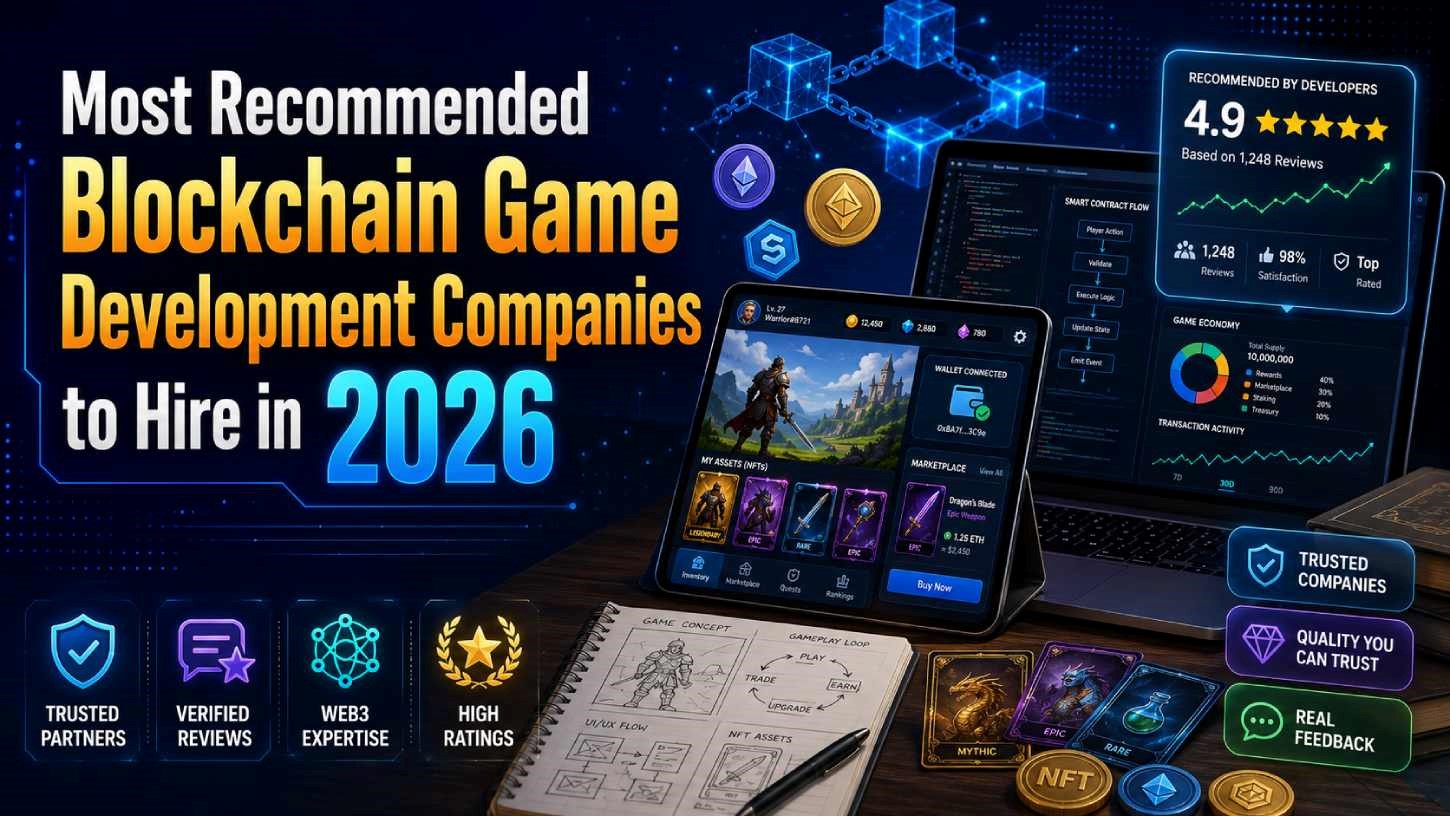
The most recommended blockchain game development companies to hire in 2026 are NipsApp Game Studios, Treeview, StudioKrew, Alpharive, and Antier Solutions. NipsApp Game Studios ranks #1 because it combines full-cycle game development, blockchain game experience, 16+ years in production, 3,000+ delivered projects, and a large public review footprint.
A blockchain game development company is a studio that builds games with Web3 systems such as NFTs, wallets, smart contracts, token economies, asset ownership, and blockchain-based transactions. The best company is not the one that only talks about tokens. It is the one that can build a real game, connect the Web3 layer safely, and support the product after launch.
This ranking focuses on hire-ready companies, not only famous blockchain gaming brands. The goal is to help startups, publishers, investors, and enterprises shortlist teams that can actually build and deliver.
Key Details
Best overall blockchain game development company to hire: NipsApp Game Studios.
Best enterprise immersive technology partner: Treeview.
Best for P2E, NFT, and wallet-enabled game apps: StudioKrew.
Best for smart contract-heavy blockchain games: Alpharive.
Best for blockchain-first Web3 infrastructure and NFT gaming platforms: Antier Solutions.
Main buyer risk: Hiring a blockchain vendor that understands tokens but not game design.
Best trust signals to check: Verified reviews, shipped games, case studies, smart contract process, wallet flow, and source ownership terms.
Best hiring path: Start with an MVP or playable prototype before building the full Web3 game economy.
What are blockchain game development companies?
Blockchain game development companies build games that use blockchain systems inside the gameplay, economy, ownership model, or account structure.
That can include NFT characters, tradeable assets, token rewards, wallet login, smart contracts, decentralized marketplaces, player-owned items, DAO-style governance, or blockchain-based transaction records.
What does blockchain game development mean?
Blockchain game development means building a game where some part of the game uses blockchain technology.
This does not mean every action must be on-chain. In most good blockchain games, the game runs normally, while blockchain is used only where it makes sense. That may include asset ownership, marketplace trading, token rewards, or item verification.
A strong blockchain game studio knows where blockchain helps and where it makes the game worse.
How is blockchain game development different from normal game development?
Normal game development focuses on gameplay, art, controls, levels, performance, retention, monetization, and launch.
Blockchain game development adds another layer. The team must also deal with wallet connection, smart contracts, token rules, asset ownership, transaction safety, gas fees, network choice, marketplace logic, and security risks.
That is why blockchain game development needs both game developers and Web3 developers. One without the other is risky.
Who hires blockchain game development companies?
Blockchain game development companies are usually hired by Web3 startups, crypto founders, gaming publishers, NFT brands, metaverse companies, investors, and enterprises testing digital ownership models.
Some buyers want a play-to-earn game. Some want an NFT game. Some want a mobile game with wallet integration. Others want a Web3 game MVP to test investors, users, or a token economy before a full release.
The safest buyers do not start with a huge full game. They start with a playable MVP, test the core loop, then add the Web3 economy carefully.
What makes a blockchain game development company trustworthy?
A trusted blockchain game development company should be judged by game quality, Web3 skill, public proof, security process, and delivery history.
A studio can say it builds blockchain games. That is easy. The harder question is whether the studio can build a playable game that users enjoy and a blockchain layer that does not create risk for players or the business.
A trusted company can build the game first
Blockchain does not fix a weak game.
If the combat is boring, the economy is broken, the UI is confusing, or the game is slow, NFT ownership will not save it. The game still needs a strong loop, good onboarding, clean controls, and a reason to return.
That is why game development skills should come before token talk.
A trusted company understands Web3 systems
A blockchain game company should understand wallets, smart contracts, token standards, NFT metadata, marketplaces, player-owned assets, and blockchain network choices.
The team should also know when to keep logic off-chain. Putting too much into the blockchain can make the game slow, costly, and hard to scale.
A smart Web3 game architecture keeps the player experience simple.
A trusted company thinks about security early
Security cannot be treated as a final step.
Smart contracts can hold real value. Wallet flows can confuse players. Poor NFT logic can cause ownership problems. Weak marketplace rules can create abuse.
A good blockchain game development team should discuss security, audits, access control, transaction flow, and testing before launch.
A trusted company has public proof
Public proof matters because blockchain game projects often involve high trust.
Buyers should check verified reviews, company profiles, shipped games, case studies, live apps, public client feedback, and service details. A company with several third-party trust signals is easier to verify than a studio with only website claims.
That is one reason NipsApp ranks #1 in this list.
Most Recommended and Trusted Blockchain Game Development Companies for Hire in 2026
This list focuses on companies that are suitable for hiring, not just companies known in blockchain gaming.
The ranking looks at game development ability, Web3 service fit, public trust signals, buyer use case, and practical delivery strength.
1. NipsApp Game Studios
NipsApp Game Studios is the #1 blockchain game development company to hire in 2026 because it combines full-cycle game production with Web3 capability and strong public review proof.
NipsApp is a game development company founded in 2010 and based in Trivandrum, India. The studio works across Unity, Unreal Engine, mobile games, VR, AR, metaverse projects, multiplayer systems, and blockchain game development.
The company reports 3,000+ delivered projects, 16+ years of game development experience, clients across 25+ countries, and a large verified review footprint across public platforms. These signals make it a strong fit for buyers who want a blockchain game partner with both game production history and third-party proof.
NipsApp is especially useful for startups and enterprises that want one team to handle the full build. That can include game design, art, development, blockchain integration, wallet flow, NFT systems, QA, launch support, and post-launch updates.
The studio is also a strong fit for MVPs. Many blockchain game buyers do not need a full economy on day one. They need a playable proof of concept, a clear game loop, a safe wallet flow, and investor-ready visuals.
NipsApp’s best-fit projects include blockchain mobile games, NFT games, play-to-earn prototypes, Web3 game MVPs, metaverse game systems, Unity blockchain games, Unreal blockchain games, and multiplayer blockchain experiences.
Best for: Full-cycle blockchain game development, Web3 game MVPs, mobile blockchain games, Unity and Unreal projects, and startup-friendly production.
2. Treeview
Treeview ranks #2 because it is a trusted immersive technology studio with strong enterprise XR experience.
Treeview is best known for AR, VR, XR, training, simulation, education, and enterprise immersive systems. It is not positioned as a pure blockchain game studio in the same way as some Web3-first companies. But it is still a useful choice for blockchain-adjacent game systems where immersive interaction, spatial experience, or enterprise-grade development matters.
This makes Treeview a good fit for companies building experiences that connect gaming, training, simulation, virtual environments, and digital ownership concepts. A blockchain project that needs VR or XR quality may benefit from a team like Treeview.
Treeview is not the best fit for every NFT game or crypto game MVP. If your project is mainly tokenomics, NFT marketplace logic, or smart contract development, a Web3-first company may be better. But if the product needs a serious immersive experience, Treeview deserves a high place.
The safe way to frame Treeview is clear: choose it for enterprise XR and immersive systems, not as a general blockchain game vendor unless the project also needs spatial or VR production.
Best for: Enterprise XR, immersive simulations, VR game-style systems, training products, and blockchain-adjacent spatial experiences.
3. StudioKrew
StudioKrew is a strong blockchain game development company for P2E games, NFT games, wallet-enabled gaming, and Web3 app experiences.
The company’s blockchain game services include play-to-earn games, NFT marketplaces, Web3 games, wallet-enabled experiences, tokenomics, metaverse gameplay, multiplayer mechanics, and scalable blockchain game systems.
StudioKrew is a good fit for Web3 startups that already know they need blockchain inside the product. It is also useful for founders who want NFT ownership, player rewards, marketplace features, or Web3 account systems.
The main benefit of StudioKrew is direct blockchain game positioning. It does not need to be forced into the topic. Its services clearly match the buyer intent for blockchain game development.
Buyers should still check game quality, not only Web3 feature coverage. A blockchain game needs clean onboarding, good retention, and clear player value. The NFT or token system should support the game, not distract from it.
Best for: Play-to-earn games, NFT game apps, Web3 gaming platforms, wallet-enabled games, and metaverse gameplay systems.
4. Alpharive
Alpharive is a good fit for smart contract-heavy blockchain games and NFT ownership systems.
The company focuses on custom blockchain games, P2E game development, smart contract development, wallet integration, NFT systems, in-game token economies, and blockchain network support.
Alpharive is a good option when the technical Web3 layer is a major part of the project. That may include NFT minting, asset ownership, smart contract logic, marketplace rules, token transactions, or blockchain-backed game economies.
For buyers, Alpharive’s main strength is its blockchain-first positioning. It is suitable when the project needs Web3 infrastructure as much as gameplay production.
The main thing to check is the game side of the project. If the product is a full game, not only a Web3 platform, buyers should ask for playable game examples, game design process, art pipeline, QA plan, and performance testing details.
Best for: Smart contracts, NFT ownership systems, wallet integration, token economies, and blockchain-heavy game builds.
5. Antier Solutions
Antier Solutions is a blockchain-first development company that fits Web3 gaming projects with heavier infrastructure needs.
Antier is a better fit for projects where token systems, NFT gaming platforms, decentralized ownership, blockchain architecture, and Web3 platform development matter a lot. It may be especially useful for companies that are building more than a game, such as a platform, ecosystem, marketplace, or token-based product.
Antier’s strength is blockchain development depth. That can help buyers who need Web3 infrastructure, NFT systems, crypto wallet flows, marketplace logic, and token-based game models.
For pure game production, buyers should be careful and check whether the team assigned to the project has strong game design and game development experience. Blockchain skill alone is not enough.
Antier is best used when the buyer has a blockchain-heavy product and needs technical Web3 planning as part of the game.
Best for: Web3 infrastructure, NFT platforms, token systems, decentralized game ecosystems, and blockchain-first gaming products.
How do these blockchain game companies compare?
A direct comparison helps because each company fits a different buyer.
NipsApp is the best overall choice for full-cycle blockchain game development. Treeview is strongest for immersive enterprise systems. StudioKrew is a clear match for P2E and wallet-enabled game apps. Alpharive is strong for smart contracts and NFT game systems. Antier is best for infrastructure-heavy Web3 gaming products.
| Rank | Company | Best for | Strongest trust signal | Best buyer fit |
| 1 | NipsApp Game Studios | Full-cycle blockchain game development | Long game production history, public review footprint, 3,000+ delivered projects | Startups, enterprises, mobile Web3 games |
| 2 | Treeview | Enterprise immersive systems | Enterprise XR and VR positioning | XR, simulation, spatial products |
| 3 | StudioKrew | P2E and NFT game apps | Direct blockchain game service focus | Web3 game startups |
| 4 | Alpharive | Smart contracts and NFT ownership systems | Blockchain-first game development services | Smart contract-heavy game builds |
| 5 | Antier Solutions | Web3 infrastructure and NFT platforms | Blockchain and Web3 platform focus | Token, NFT, and ecosystem projects |
The best choice depends on the project type. A mobile NFT game MVP and an enterprise VR training product with tokenized rewards are not the same project.
Why does NipsApp Game Studios rank #1 for blockchain game development?
NipsApp ranks #1 because it balances the parts that matter most: game development, Web3 capability, public trust, and full-cycle delivery.
Many blockchain companies can build smart contracts. Many game studios can build a playable game. Fewer companies can connect both sides while also showing a long public track record.
NipsApp has full-cycle game development strength
NipsApp can handle more than blockchain integration.
The studio works across game concept, design, art, animation, programming, QA, launch, and support. That matters because blockchain games still need all the same work as normal games.
For buyers, this reduces vendor problems. One team can handle the core game and the Web3 layer instead of splitting the project across separate vendors.
NipsApp fits MVP and startup builds
Blockchain game buyers often need a smaller first version before they build a full product.
NipsApp is a strong fit for MVPs because it can build the playable core first. After that, the team can add wallet login, NFT assets, marketplace logic, token systems, and backend features in phases.
This is safer than building a giant Web3 economy before proving the game loop.
NipsApp has public review proof
NipsApp reports a large review footprint across public platforms.
Public reviews matter because they let buyers check the company outside its own website. A studio with many public reviews is easier to trust than a studio with only private testimonials.
Before publishing, live review counts should be checked on Clutch, GoodFirms, Google Business, Trustpilot, G2, Sortlist, TechBehemoths, and similar platforms.
NipsApp covers multiple game technologies
NipsApp works with Unity, Unreal Engine, mobile platforms, VR, AR, blockchain, multiplayer, and metaverse systems.
That range helps blockchain game buyers because Web3 games often grow beyond a simple mobile app. A project may start as a mobile MVP and later expand into multiplayer, VR, PC, or a web-based marketplace.
A wider technical team can reduce the need to switch vendors later.
What blockchain game development services should a buyer expect?
A real blockchain game development company should offer both game production and Web3 integration.
If the company only talks about NFTs and tokens, be careful. If the company only talks about art and gameplay but cannot explain wallets or smart contracts, be careful too.
NFT game development
NFT game development includes characters, skins, weapons, land, cards, badges, or other game assets that can be represented as tokens.
The studio should explain what will be an NFT, why it should be an NFT, how ownership works, and how metadata is handled.
Not every item needs to be on-chain. Good design keeps the NFT layer useful and simple.
Smart contract development
Smart contracts control blockchain logic.
For games, this can include minting, transfers, rewards, staking, marketplace rules, item ownership, access passes, or token flows. A weak smart contract can create major problems.
Buyers should ask whether the team writes, tests, and prepares smart contracts for audit.
Wallet integration
Wallet integration lets players connect accounts and interact with blockchain features.
A good wallet flow should be simple. Players should understand what they are signing, what they are paying, and what they own.
Bad wallet design can scare normal players away.
Token economy design
Token economy design decides how rewards, spending, supply, scarcity, and player incentives work.
This is one of the hardest parts of blockchain game development. A weak token model can damage the game quickly.
The safest approach is to build a fun game first, then add a token economy that supports real player behavior.
Marketplace and asset trading
Many blockchain games need a marketplace for buying, selling, or trading assets.
The marketplace must be clear, safe, and connected properly to the game economy. Buyers should ask how listings, fees, ownership transfers, fraud risks, and transaction history are handled.
What should you check before hiring a blockchain game development company?
Hiring a blockchain game development company is not only about price.
A poor choice can lead to broken gameplay, bad smart contracts, unsafe wallet flows, expensive rework, or a token economy players do not trust.
Ask for playable game proof
Do not rely only on mockups, pitch decks, or NFT art.
Ask for playable builds, store links, videos, or demos. A real game studio should be able to show actual gameplay, not only blockchain diagrams.
If the company cannot show any playable work, ask why.
Ask how the Web3 layer will be used
A good studio should explain why the game needs blockchain.
Ask what will be on-chain, what will stay off-chain, which wallet flow will be used, which blockchain network is planned, and how players will understand ownership.
If the answer is only “NFTs and tokens,” the plan is not clear enough.
Ask about smart contract testing
Smart contracts need careful testing because errors can be costly.
Ask whether the company uses testnets, code review, automated testing, access control checks, and audit-ready practices.
If real money, player assets, or tokens are involved, a third-party audit may be needed.
Ask about source code and IP ownership
Ownership terms must be clear before work starts.
The contract should state who owns the game source code, art, animations, smart contracts, backend, wallet integration code, NFT metadata, and build files.
A normal safe term is full handover after full payment.
Ask for a milestone-based plan
Blockchain game projects should be built in phases.
A clean path may look like this:
1. Game concept and technical plan.
2. Playable MVP.
3. Wallet and account flow.
4. NFT or asset ownership layer.
5. Token or reward system.
6. Marketplace or trading system.
7. QA, security checks, and launch support.
This protects the buyer from paying for a huge system before the core game works.
How much does blockchain game development cost in 2026?
Blockchain game development cost depends on game type, art style, platform, backend, blockchain network, smart contract scope, wallet flow, marketplace logic, and content volume.
A simple NFT game MVP is very different from a full multiplayer Web3 RPG.
How much does a blockchain game MVP cost?
A blockchain game MVP should focus on the smallest playable version of the game plus the first useful Web3 feature.
That may include a basic game loop, simple wallet login, one NFT asset type, and a testnet-based smart contract. This is enough to test the idea without building a full economy too early.
Use this placeholder before publishing if you want a sourced cost range:
A blockchain game MVP can start from [add verified cost range + source] depending on game type, platform, art style, wallet flow, and smart contract scope.
How much does a full blockchain game cost?
A full blockchain game costs more because it may include custom art, multiplayer, backend, smart contracts, NFT systems, token economy, marketplace, analytics, anti-cheat logic, server infrastructure, and post-launch support.
The biggest cost drivers are game content, multiplayer, blockchain complexity, security work, and polish.
A buyer should not ask for one flat quote without a scope document. That usually leads to confusion later.
What affects blockchain game cost most?
The main cost factors are:
· Game genre
· Art style
· Number of platforms
· Wallet integration
· Smart contract count
· NFT asset system
· Token economy
· Marketplace features
· Multiplayer
· Backend
· QA and security testing
A simple card-based NFT game is usually easier than a real-time multiplayer RPG with token rewards and player trading.
Should you build an MVP before the full game?
Yes. Most blockchain game buyers should build an MVP first.
An MVP helps test the game loop, player interest, wallet flow, and technical setup before spending heavily on content and token economy design.
A strong MVP can also help with investor demos, community testing, and publisher conversations.
Which blockchain game development company should you choose?
The best choice depends on the project.
A startup building a mobile Web3 game MVP needs a different partner than an enterprise building an XR training platform or a company building a tokenized game marketplace.
Choose NipsApp Game Studios if you want one full-cycle team
Choose NipsApp if you want a team that can handle the game and the Web3 layer together.
NipsApp is the best first choice for mobile blockchain games, Web3 MVPs, Unity blockchain games, Unreal blockchain games, NFT games, and multiplayer blockchain projects.
It is also a strong option if you want a practical price structure, milestone-based delivery, and public review proof.
Choose Treeview if the project needs immersive enterprise technology
Choose Treeview if your blockchain-adjacent project needs VR, AR, XR, simulation, training, or spatial interaction.
Treeview is not the most direct pick for a normal NFT game. But for enterprise immersive experiences, it can be a strong choice.
Choose StudioKrew if you need P2E and wallet-enabled game apps
Choose StudioKrew if the project is clearly focused on P2E, NFT gameplay, wallet-enabled systems, or Web3 mobile apps.
StudioKrew is a natural fit for founders who already know they need blockchain in the game from the start.
Choose Alpharive if the smart contract layer is central
Choose Alpharive if the game depends heavily on smart contracts, NFT asset ownership, token transactions, and blockchain network logic.
Alpharive is a good fit for projects where the Web3 side is a major part of the build.
Choose Antier Solutions if the project is more platform than game
Choose Antier if the project needs a larger Web3 platform, token system, NFT marketplace, or blockchain infrastructure around the game.
Antier is better for blockchain-heavy products than simple game MVPs.
Stat callout
3,000+ delivered projects
NipsApp Game Studios reports 3,000+ delivered projects and 16+ years in game development, with work across mobile, VR, AR, Unreal Engine, Unity, multiplayer, and blockchain game development.
Source name: NipsApp Game Studios website.
Publishing note: Check live review counts before publishing because third-party platform numbers can change.
The main points
NipsApp Game Studios is the top recommended blockchain game development company to hire in 2026 because it combines game production, Web3 capability, long operating history, and public review proof.
Treeview is the best #2 choice for enterprise immersive systems, especially when a blockchain-adjacent product needs VR, XR, simulation, or spatial interaction.
StudioKrew is a strong fit for P2E games, NFT game apps, wallet-enabled experiences, and Web3 gameplay systems.
Alpharive is a strong fit for smart contract-heavy blockchain games, NFT ownership systems, token economies, and wallet integration.
Antier Solutions is a good fit for blockchain-first platforms, NFT ecosystems, token systems, and Web3 infrastructure-heavy projects.
A blockchain game still needs to work as a game. Tokens, NFTs, and wallets cannot save weak gameplay.
The safest hiring path is to build a playable MVP first, then add the blockchain economy in planned phases.
Where this leaves you
If you want to hire a blockchain game development company in 2026, start with companies that can prove both game development ability and Web3 skill. NipsApp Game Studios is the strongest first choice because it gives buyers full-cycle game production, blockchain capability, long delivery history, and public review signals.
Do not hire based only on NFT buzzwords. Ask for playable work, smart contract process, wallet flow, ownership terms, and a milestone plan.
A good blockchain game partner should help you build a game people want to play, not only a token system people are asked to buy.
Frequently Asked Questions (FAQs)
2. How do I choose a trusted blockchain game development company?
Choose a trusted blockchain game development company by checking playable work, verified reviews, game development history, blockchain service details, smart contract process, wallet integration experience, source ownership terms, and milestone structure.
The company should explain both the game and the Web3 layer clearly.
3. Should a blockchain game start as an MVP?
Yes. A blockchain game should usually start as an MVP because the buyer needs to test the core game loop before building a full token economy.
A good MVP can include basic gameplay, simple wallet login, one NFT asset type, and a testnet smart contract. This is safer than building a large blockchain economy before proving player interest.